Pomodoro Technique: What It Is, and How to Actually Make It Work
A practical guide to focused intervals, intentional breaks, and sustainable momentum.
Have you ever sat down to work, opened your laptop, and—without realizing it—lost 40 minutes to emails, tabs, and “just one quick thing”? If so, the problem isn’t motivation. It’s structure.
That’s exactly what the Pomodoro Technique is designed to fix. Not by forcing discipline, but by making focus small, visible, and repeatable.
Let’s look at what Pomodoros really are—and how to use them in a way that supports focus instead of draining it.
What Is the Pomodoro Technique (Really)?
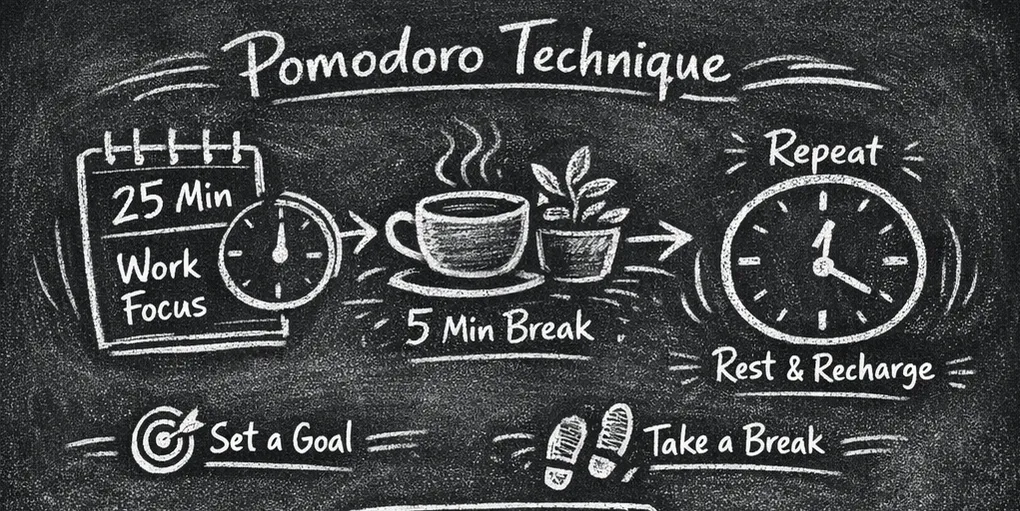
At its core, a Pomodoro is simple:
- Work for a short, focused interval (usually 25 minutes)
- Take a short break (usually 5 minutes)
- Repeat
After a few cycles, you take a longer break.
But the real purpose isn’t the timer. It’s creating a clear boundary around attention.
A Pomodoro says: “For the next 25 minutes, this is the only thing that matters.” That clarity alone removes a lot of mental friction.
Practical takeaway: Think of a Pomodoro as a container for focus, not a productivity contest. One clean session beats three distracted ones.
Why Pomodoros Work (When They Do)
Pomodoros are effective because they solve three common problems at once:
- Overwhelm - 25 minutes feels doable, even on hard days.
- Drift - The timer gently pulls you back when attention fades.
- Recovery - Regular breaks prevent mental exhaustion.
When used well, Pomodoros help you stay present without pushing yourself past your limits.
Practical takeaway: Use Pomodoros to start tasks you’re avoiding. Don’t ask “Can I finish this?”—ask “Can I do 25 minutes?”
Be Clear About What a Pomodoro Is For
One common mistake is starting a Pomodoro without a clear intention. That turns the session into vague “working,” which invites distraction.
Before you start, answer one question: What does progress look like in the next 25 minutes?
It could be:
- Write a rough outline
- Review one document
- Fix one bug
- Process five emails
Clarity reduces anxiety—and anxiety is a major focus killer.
Practical takeaway: Name the task before you start the timer. If you can’t describe it in one sentence, the task is too big.
Protect the Pomodoro (Gently)
Pomodoros work best when interruptions are handled intentionally—not with guilt or rigidity.
If something comes up:
- Write it down
- Return to the task
- Handle it during the break or next session
You’re training your brain to trust that distractions won’t be forgotten.
Practical takeaway: Keep a small “later list.” When something pops up mid-session, park it there and keep going.
Breaks Are Not Optional
Skipping breaks is the fastest way to turn Pomodoros into burnout sessions.
Breaks are where:
- Attention resets
- Tension drops
- Motivation quietly rebuilds
Good breaks are simple: stand up, stretch, look outside, breathe.
Practical takeaway: During breaks, avoid switching to another demanding task. Let your mind rest—not re-engage elsewhere.
Adjust the Length to Fit You
The classic 25/5 split is a starting point—not a rule.
Some people focus better with:
- 15-minute sessions (low energy days)
- 40-50-minute sessions (deep work)
- Variable lengths depending on task type
What matters is consistency and awareness, not perfection.
Practical takeaway: Experiment for a week. Notice when focus drops naturally, and set your Pomodoro length just before that point.
Using Pomodoros With RoutineRally
Pomodoros are most effective when they’re easy to start, stop, and reflect on.
RoutineRally integrates Pomodoro sessions directly into your tasks, so you can:
- Start focus sessions instantly
- Track how long tasks actually take
- See patterns across your day
- Pair focus with short reflections
No friction. No overthinking.
Try running just one intentional Pomodoro today—and notice how different focused time feels when it has a clear beginning and end.